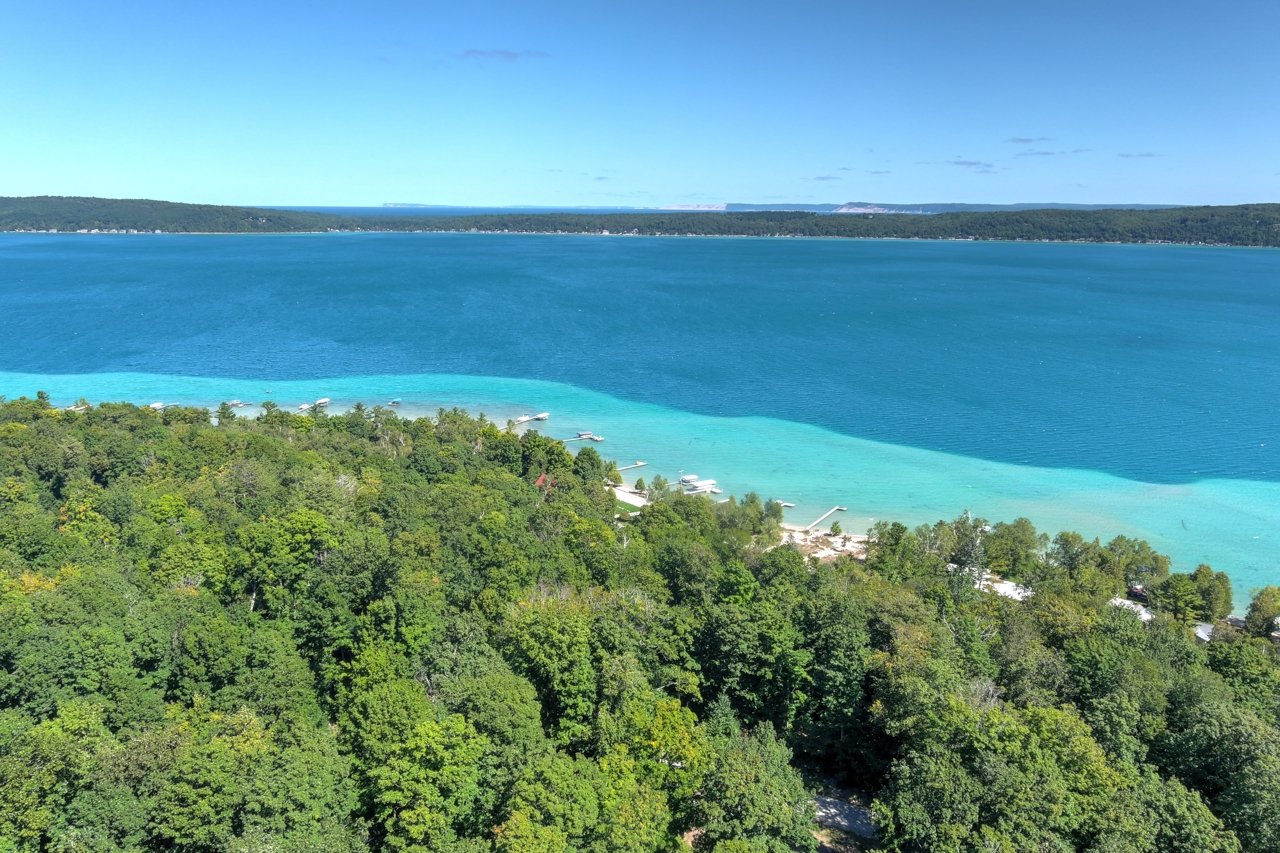
Whether it's a cottage on Crystal Lake, a home along the Betsie River, a retreat on Big Platte Lake, or a Lake Michigan property, waterfront ownership comes with more than a beautiful view. It also comes with a unique set of property rights, responsibilities and terminology that can be confusing, even for longtime Michigan property owners.
What exactly are riparian rights? What are littoral rights? Who owns the lake or river bottom? What does “navigable” mean? And where does your property actually end?
As your Up North Waterfront Experts, we believe understanding these distinctions is an important part of understanding waterfront ownership. Let's take a closer look at some of the terms you'll hear most often.
Riparian Rights: What Do They Actually Mean?
Riparian rights are the rights associated with owning property along an inland lake, river or stream.
In Michigan, these rights can include access to navigable waters, dockage to boatable water, reasonable use of the water and certain rights associated with natural changes to the shoreline. They are subject to Michigan law, environmental regulations and the rights of neighboring property owners.
For example, owning a home directly on Crystal Lake generally gives you a bundle of rights that a home a few blocks away with deeded lake access may not have.
Those rights can include the ability to:
- Access the water from your property
- Use the water for reasonable purposes such as swimming and boating
- Maintain dockage to boatable water, subject to applicable rules
- Exercise certain ownership rights over the bottomland associated with your property
Riparian rights are important but they aren't unlimited. They do not mean you own the lake in front of your house or can do whatever you want to the shoreline or lake bottom.
The simplest way to think about it: Waterfront ownership gives you a special bundle of rights connected to your property and the water—not unlimited control over the water itself.
Littoral Rights: The Lakefront Version
This is one of those terms that can be confusing because it sounds similar to riparian rights.
Traditionally, the distinction is simple:
- Riparian rights are associated with property along a river or stream.
- Littoral rights are associated with property along a lake.
In Michigan real estate, however, you'll often hear “riparian rights” used broadly when discussing both lakefront and riverfront property. Michigan statutes and environmental guidance also commonly use riparian terminology for owners whose property borders inland lakes and streams.
So if you're buying a home on Crystal Lake, Big Platte Lake, or the Betsie River, don't get too hung up on the vocabulary.
The more important question is: What rights actually come with this particular property?
The deed, legal description, plat, easements, waterbody and applicable laws all matter.
Navigable Waters and the Public Trust Doctrine
You've probably heard a lake or river described as “navigable.” In simple terms, navigable waters are waters legally recognized as available for public navigation. But navigable doesn't simply mean “big enough to take a boat on.” Michigan's legal definition is more nuanced.
For navigable inland lakes and streams, Michigan's public trust doctrine protects certain public rights, including navigation and fishing.
This creates an important distinction for waterfront homeowners: You can own waterfront property -- and may even own the bottomland beneath the water adjacent to your property -- while the public can still have certain rights to use the navigable water.
Here's an example: Imagine you own a home on Crystal Lake. You may have riparian rights associated with your waterfront and ownership rights in the bottomland adjacent to your property. But that doesn't necessarily give you the right to tell someone who has lawfully accessed the lake that they cannot boat or fish in front of your house.
At the same time, public rights in navigable water do not mean the public can cross your private yard or shoreline to reach it. Public use of the water and private ownership of the land can exist at the same time.
That's one of the most important concepts to understand about waterfront ownership.
Bottomlands: Do You Own the Lake or River Bottom?
For natural inland lakes and streams in Michigan, the bottomlands below the ordinary high-water mark are generally owned by adjacent riparian property owners. Depending on the property and its legal description, those ownership interests may extend outward toward the center of a lake or river.
For example, a homeowner on Big Platte Lake may own not only the land where the house sits but also a portion of the lake bottom extending outward from the shoreline.
A homeowner whose property borders the Platte River may similarly own the bottomland associated with the property, generally extending toward the center of the river.
But there is an important distinction:
Owning the bottomland does not mean owning the water above it.
Public trust protections still apply to navigable inland waters, and activities affecting the lake or river and its natural resources may be subject to state regulation.
Not every waterbody follows the same ownership model. Artificial lakes, impoundments and certain platted waterbodies may have different arrangements, making the property's deed and legal history particularly important.
Lake Michigan Is Different
If you're considering a property along the Lake Michigan shoreline in Frankfort, Arcadia, or another Lake Michigan waterfront community, there's another important distinction to understand.
Great Lakes waterfront is treated differently from inland lakes and streams.
Michigan holds the bottomlands of the Great Lakes below the ordinary high-water mark in trust for the public and regulates uses and occupations of those bottomlands under its Great Lakes Submerged Lands program.
That means a Lake Michigan homeowner's relationship to the shoreline and bottomland can be different from that of a homeowner on Crystal Lake or one of the Platte lakes.
It's another reason not to assume that rules applying to one waterfront property automatically apply to another.
Ordinary High-Water Mark: Where Does the Land End?
The ordinary high-water mark, or OHWM, is an important term when discussing waterfront property boundaries, improvements and permits. For Michigan inland lakes and streams, it is essentially the line between upland and bottomland. EGLE identifies it by looking at physical characteristics showing where the presence and action of water regularly changes the character of the land.
Why does that matter?
Because activities below the ordinary high-water mark can be regulated differently from ordinary upland property. Dredging, filling or placing certain structures on bottomland may require a permit under Michigan's Inland Lakes and Streams program.
So even if a homeowner owns the bottomland, that doesn't mean they can do whatever they want with it.
Waterfront ownership and environmental regulation are two different things.
What About Docks?
For many waterfront buyers, this is the practical question that matters most: Can I put a dock here?
Michigan recognizes dockage to boatable water as one of the rights associated with riparian property. However, not every dock, hoist or shoreline structure is automatically permitted.
Certain seasonal private docks and hoists may qualify for exemptions under specific conditions, while permanent structures or other improvements may require permits.
There are also considerations involving neighboring property owners and unreasonable interference with the use of the water.
When buying waterfront, don't simply ask, “Does it have a dock?”
Ask:
- Is the dock properly permitted?
- What rights come with it?
- What can I legally do with it in the future?
Sellers should also be prepared to answer these questions when preparing a waterfront property for market.
Waterfront vs. Lake Access: They're Not the Same
This is one of the biggest distinctions buyers should understand.
A property can have lake access without being waterfront.
For example, a home near Crystal Lake might have deeded access through an easement, shared waterfront parcel, association or platted access point. A backlot owner may have the right to walk to the water, launch a kayak or use a shared beach.
Those rights come from the specific deed, easement, plat or other governing documents. They aren't automatically the same rights that come with owning property directly on the water.
When evaluating a property, it's important to understand exactly what you're buying.
Why This Matters When Buying or Selling Waterfront
Waterfront real estate isn't simply about how many feet of shoreline a property has.
The type of waterbody, legal description, access rights, easements, bottomland ownership, shoreline conditions, existing improvements and applicable regulations can all matter.
Two properties that both advertise “lake access” may provide very different ownership experiences. Two lakefront properties may have different rights because of their deeds, plats or other recorded documents. And a property with an existing dock or seawall may have permitting or maintenance considerations that aren't obvious from a listing.
That's why waterfront deserves a little more due diligence than simply looking at the view.
Questions worth asking before buying or selling waterfront:
- Is the property actually waterfront, or does it have deeded access?
- What type of waterbody does it border?
- Is the waterbody navigable?
- What riparian rights accompany the property?
- What does the legal description actually include?
- Who owns the bottomland?
- Where is the ordinary high-water mark?
- Are existing docks, hoists or shoreline structures properly permitted?
- Are there easements, shared-access agreements or association restrictions?
- Could shoreline changes affect the property?
Your Up North Waterfront Experts
From Crystal Lake and the Platte Lakes to the Betsie River and Lake Michigan, Northern Michigan waterfront comes with its own language, regulations and considerations.
At The Jon Zickert Group, we believe waterfront expertise means more than knowing what a property is worth. It means understanding the questions that make waterfront property different from every other kind of real estate.
Got waterfront questions? We're here to help!
This article is intended for general educational purposes and is not legal advice. Waterfront rights can vary based on a property's deed, legal description, plat, easements, waterbody, historic conveyances and applicable federal, state and local laws. Always consult a qualified Michigan real estate attorney or other appropriate professional regarding the specific rights and restrictions associated with a particular property.